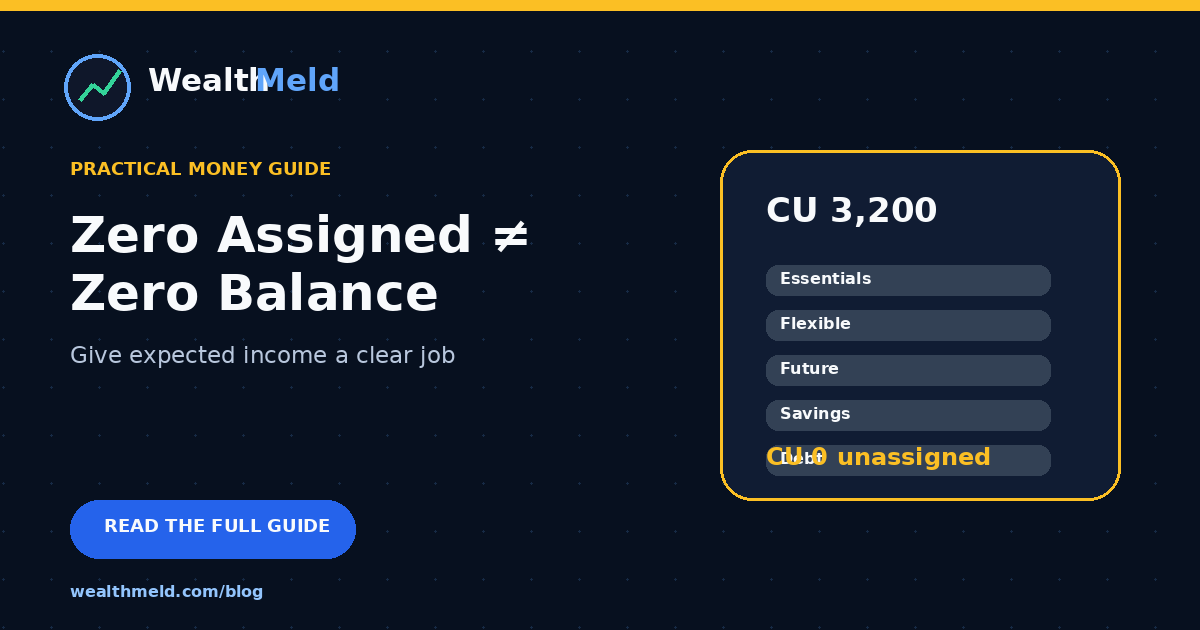
A zero-based budget assigns all income available for the planning period to named purposes. In its simplest form:
planned income − planned allocations = 0
Allocations can include bills, everyday spending, savings, investing, future irregular costs, debt payments and giving. “Zero” means no income is left without a job in the plan. It does not mean spending every unit, emptying your bank account or ending the month with no savings.
The method can be useful when you want an explicit plan rather than broad spending limits. It still needs flexibility: income and costs can change after the month begins.
Before you begin: define the planning amount
Start with income you reasonably expect to receive during the period. Use the amount available after deductions already made, not a gross figure that cannot all be spent.
If income is irregular, use cleared income, a cautious baseline or separate scenarios. Do not assign a hoped-for payment to essential bills before it arrives. The companion Cash Buffer for Irregular Income explains one way to handle variable receipts after that article passes review.
Also decide how to treat money already in your accounts. Existing savings do not need to be “spent down” to make the new month equal zero. Label them by purpose—such as an annual-bills pot or cash buffer—and assign only the income and balances you deliberately include in this plan.
Step 1: list essential obligations
Record housing, basic food, utilities, essential transport, healthcare, insurance and required debt payments that apply to you. Check due dates as well as totals; a month can balance on paper but still have a timing shortfall.
If planned income does not cover essentials, the goal is not to force the equation to zero with unrealistic cuts. Prioritise urgent needs, check trustworthy local support and contact providers early if you may miss a payment.
Step 2: plan flexible spending
Estimate categories that vary, such as groceries above the basic amount, household items, clothing, entertainment and eating out. Use recent transactions as evidence. A plan based on an ideal month is likely to need constant repair.
You do not need dozens of categories. Use enough detail to make decisions. If “miscellaneous” repeatedly becomes large, split it into the two or three things actually driving it.
Step 3: include future irregular costs
Annual renewals, repairs, travel, gifts and other non-monthly costs can disrupt a plan when they are invisible. Create a named allocation for each relevant future cost.
For example, if a CU 480 bill is due in eight months and nothing has been saved yet, CU 60 per month would reach CU 480 if all eight contributions are made. This is arithmetic, not a guarantee that the estimate or timing will remain accurate.
Step 4: assign savings, investing and extra debt payments
Savings are a use of income, not leftover money outside the budget. Give each contribution a purpose and distinguish short-term cash needs from long-term investments. Investment values can fall and are not assured to be available at the amount or time expected.
If paying more than a required debt amount, check the agreement for fees, allocation rules or early-payment conditions. The Debt Payoff Calculator can compare simplified scenarios, but the provider’s terms control the real debt.
Step 5: make the plan equal zero
Add every allocation and subtract the total from planned income.
- If the result is positive, assign the remainder to a real category rather than leaving it vague.
- If the result is negative, reduce lower-priority allocations or revisit the income assumption. Do not double-count savings or rely on credit as income.
- If the result is zero, check that the plan still includes timing, irregular costs and some room for ordinary variation where appropriate.
Use the WealthMeld Budget Planner as a decision board, then save a copy of the assumptions you used.
Worked example: zero does not mean an empty account
Assume one person expects CU 3,200 of spendable income this month. They already have CU 2,500 in a separately labelled cash buffer; that existing reserve is not part of the CU 3,200 being assigned.
| Planned allocation | Amount |
|---|---|
| Essential obligations | CU 1,650 |
| Flexible spending | CU 550 |
| Future irregular costs | CU 250 |
| Savings contributions | CU 400 |
| Required and extra debt payments | CU 250 |
| Giving and fun | CU 100 |
| Total allocations | CU 3,200 |
Calculation: CU 3,200 income − CU 3,200 allocations = CU 0 unassigned.
Assumptions: the CU 3,200 is expected spendable income; each amount appears once; debt-payment terms have been checked separately; there is no assumed investment return; the existing CU 2,500 buffer remains labelled and available according to its account terms; taxes and payroll deductions are outside the example because the income figure is already after deductions.
The bank balance does not go to zero. CU 400 moves to savings, CU 250 is reserved for future costs and the existing CU 2,500 buffer remains intact. Zero applies only to unassigned income in this month’s plan.
Adjust the budget during the month
A zero-based budget is a plan, not a prediction. When one category changes, rebalance rather than abandoning the month.
Suppose an essential transport cost is CU 80 higher than planned. The person could move CU 50 from giving and fun and CU 30 from flexible spending. Total planned income and allocations remain equal, but the categories now reflect reality.
If income falls, rebuild the plan from the lower amount and protect urgent essentials first. If income rises, assign the extra amount deliberately. Record the change so next month’s estimates improve.
Common zero-based budgeting mistakes
Confusing zero assigned with zero balance
Money allocated to savings or future bills remains money. The method tracks its purpose; it does not require it to be spent.
Forgetting non-monthly costs
A plan can look balanced while an annual bill approaches. Review the calendar and statements for costs that do not occur every month.
Budgeting gross income
Use only the amount available to allocate after deductions already made. If you must calculate your own taxes or business obligations, do so under the applicable local rules or with qualified help before treating receipts as spendable.
Counting the same money twice
A transfer from a current account to savings is one allocation, not both a saving expense and new income. Likewise, using a credit card does not create income.
Making the plan too tight to maintain
Estimates will not be exact. Include realistic flexible amounts and revise categories when circumstances change. Precision on a spreadsheet does not guarantee that the assumptions are sound.
Monthly zero-based budget checklist
- [ ] Choose the planning period and expected spendable income.
- [ ] Keep uncertain income out of essential allocations.
- [ ] List essential obligations and due dates.
- [ ] Estimate flexible spending from recent records.
- [ ] Add future irregular costs.
- [ ] Name savings, investment and debt allocations.
- [ ] Check that each amount is counted once.
- [ ] Reconcile planned income minus allocations to zero.
- [ ] Adjust the categories when actual income or costs change.
- [ ] Review the result at month-end and update the next plan.
The Monthly Money Review Routine can provide that final check once the companion draft is approved.
Sources and further reading
Primary and public-authority sources reviewed for this draft:
- Consumer.gov — Making a Budget — U.S. government consumer guidance on recording income and expenses and using the monthly difference. Accessed 3 August 2026.
- U.S. Consumer Financial Protection Bureau — Your Money, Your Goals toolkit — official tools for tracking income, bills, spending, cash flow and savings. Updated June 2020; accessed 3 August 2026.
- OECD/INFE 2023 International Survey of Adult Financial Literacy (PDF) — international context on financial knowledge and behaviour; not evidence that one budgeting method is best for everyone. Accessed 3 August 2026.
The worked example and zero-based framework are editorial illustrations. The sources support general budgeting and tracking practices; this draft does not claim that they endorse a branded or universally superior method.
Disclaimer
This article is general educational information, not personalised financial, investment, tax, accounting or legal advice. Examples use fictional currency units and simplified assumptions. Income definitions, debt rules, taxes, benefits, product terms and suitable priorities vary by country and circumstances. Confirm obligations and product terms and consult an appropriately qualified local professional when needed.