A low monthly payment can look attractive, but it does not tell you the whole borrowing story. When you compare two loan offers, look at the rate, the fee structure, the term, and any rule that affects early repayment. If one lender gives you a slightly smaller EMI but adds a large fee, the cheaper payment can mask a higher overall cost.
This is why the EMI calculator is only the starting point. Use it to compare the payment stream, then add fees and lender rules before you decide. The goal is not to chase the lowest monthly payment; it is to choose the offer that fits your budget and your timeline.
Compare these four items first
- APR: the rate plus certain loan costs, expressed as a yearly percentage.
- Up-front fees: origination, processing, documentation, or similar charges that change the real cost.
- Term: longer terms often lower the monthly payment but usually raise total interest.
- Repayment rules: prepayment fees, rate resets, or payment timing can change the true cost of borrowing.
For mortgages, the Loan Estimate shows costs in a structured way. For other loans, the same comparison still matters even if the paperwork looks different. The practical question is always the same: how much money leaves your account over the full life of the loan?
Worked example
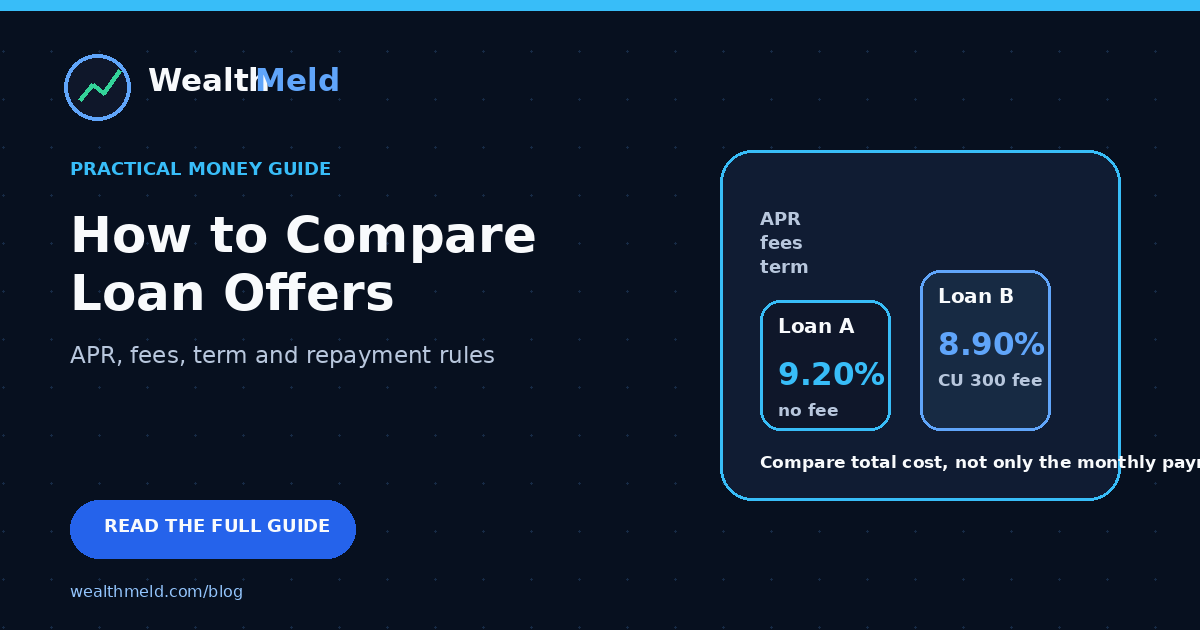
Assume two fixed-rate offers for CU 10,000 over 36 months. Offer B has the lower APR, but it also includes a CU 300 fee.
| Item | Loan A | Loan B |
|---|---|---|
| Amount | CU 10,000 | CU 10,000 |
| APR | 9.20% | 8.90% |
| Up-front fee | CU 0 | CU 300 |
| Monthly payment | CU 318.93 | CU 317.53 |
| Total repaid incl. fee | CU 11,481.44 | CU 11,731.16 |
| Total interest | CU 1,481.44 | CU 1,431.16 |
Interpretation: Loan B has the lower monthly payment and the lower APR, but its up-front fee narrows the savings. If the borrower plans to keep the loan for the full term, the total cost still matters more than the monthly difference. If the borrower expects to repay early, the fee and any prepayment rule matter even more.
Simple decision checklist
- Compare the payment only after you understand the fee structure.
- Check whether the lender charges for early repayment or refinance.
- Confirm whether the payment date lines up with your paycheck.
- Test the offer against a budget that still leaves room for savings and essentials.
- Keep the lender disclosure and your own calculation side by side.
When a slightly higher payment may be the better choice
A slightly higher payment can still be the better option if it removes a fee, shortens the term, or makes the loan easier to close early without penalty. In other words, the cheapest EMI is not automatically the cheapest loan. Compare the full plan, not just the monthly line item.
Sources and further reading
Primary sources reviewed for this guide:
- Consumer Financial Protection Bureau — What is an annual percentage rate (APR)? Explains APR as a comparison tool for borrowing costs. Accessed 6 August 2026.
- Consumer Financial Protection Bureau — Loan Estimate Shows how mortgage charges are grouped so borrowers can compare offers. Accessed 6 August 2026.
- Consumer Financial Protection Bureau — What is amortization and how could it affect my auto loan? Describes how payment schedules split principal and interest. Accessed 6 August 2026.
Disclaimer
This article is general educational information, not personalised financial, investment, tax, accounting or legal advice. Examples use simplified assumptions and currency units for illustration only. Loan terms, fees, repayment rules, savings needs and tax treatment vary by country and by your individual situation. Check the actual contract or statement before making a financial decision.