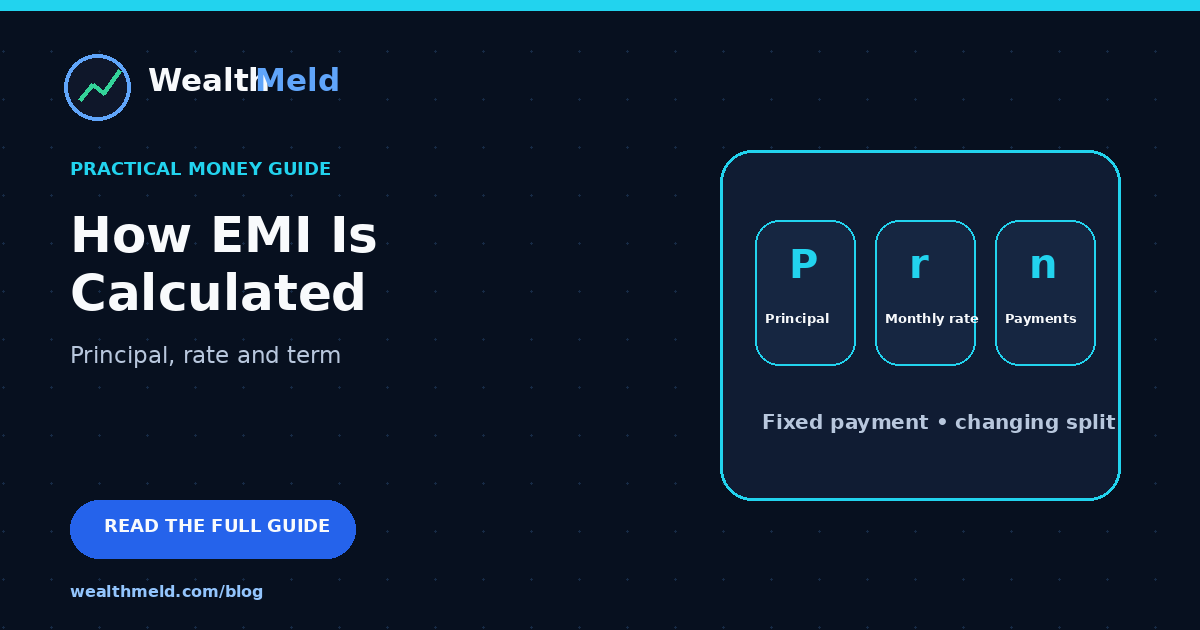
An equated monthly instalment (EMI) is a scheduled loan payment designed to repay principal and interest over a stated term. “EMI” is common terminology in India and parts of South Asia; lenders elsewhere may say “monthly payment” or “amortizing payment.” The label alone does not tell you whether taxes, insurance, fees, or optional products are included.
Scope: The formula below models a standard reducing-balance, fixed-rate loan with monthly payments. A lender's disclosure and contract control. Flat-rate loans, variable-rate loans, interest-only periods, balloon payments, daily interest and subsidized products need different treatment.
The reducing-balance EMI formula
For a genuine zero-interest loan, the formula's r = 0 form would divide by zero; use EMI = P ÷ n instead. Keep units aligned: a monthly rate requires a number of months.
Worked example: ₹20 lakh at 9% for 15 years
Assumptions
Principal P = ₹2,000,000; nominal annual rate = 9%; monthly rate r = 0.09 ÷ 12 = 0.0075; term n = 15 × 12 = 180 payments. The rate is fixed, payments occur monthly, and no fees are financed.
Calculated EMI: ₹20,285.33
Calculated total of 180 payments: ₹3,651,359.70
Calculated interest: ₹1,651,359.70
Values are shown to two decimal places. A real lender may round each instalment, adjust the final instalment, use a different day-count method, or collect fees separately. Reproduce this scenario in the Loan EMI Calculator, then compare it with the lender's amortization schedule.
Why principal and interest change while EMI stays level
In a standard reducing-balance schedule, each period's interest is based on the outstanding balance. Early payments therefore contain more interest; as principal falls, the interest component falls and more of the same payment reduces principal. This is amortization, not an extra charge.
A quoted “flat” rate can instead calculate interest using the original principal for much or all of the term. It is not directly comparable with a reducing-balance rate. Compare the disclosed annual percentage rate or equivalent total-cost measure, the amount financed, fees and total repayment—not just the headline rate or EMI.
What changes an EMI
- Amount financed: A larger down payment lowers principal, but preserve cash needed for closing costs and emergencies.
- Rate: A higher fixed rate raises both EMI and total interest. Credit assessment, collateral, product and market conditions can affect the offer.
- Term: A longer term generally lowers EMI but increases the time interest accrues. A lower payment is not automatically a cheaper loan.
- Rate resets: On a floating-rate loan, a lender may change the EMI, extend the term, or offer choices subject to the contract and local rules.
- Fees and add-ons: Processing fees, insurance or other products may be paid upfront, included in the amount financed, or collected separately.
Fixed, floating and special-payment products
A fixed rate can make the modeled instalment predictable for the fixed period, but the contract may be fixed only temporarily. A floating rate can change with its benchmark and reset schedule. The Reserve Bank of India's borrower guidance for floating-rate EMI loans discusses lender communication and options at reset; those rules apply within their stated Indian regulatory scope, not worldwide.
Interest-only, graduated-payment, negative-amortization and balloon loans do not follow the simple “same payment fully repays the balance” assumption. Promotional “no-cost EMI” offers can also involve discounts, processing charges or tax treatment. Read the product disclosure rather than inferring cost from the marketing name.
How to compare two offers
- Confirm the same amount financed and repayment term.
- Identify whether each rate is fixed, floating, flat or reducing-balance.
- Compare the APR or local equivalent, all mandatory fees and total repayment.
- Review the amortization schedule and the rules for prepayment, late payment and rate resets.
- Stress-test a floating rate and check whether the payment still fits after essential spending and savings.
In India, the RBI's 2024 Key Facts Statement requirements call for a standardized summary including APR and an amortization schedule for covered retail and MSME term loans. Coverage and implementation details matter. In the United States, the CFPB Loan Estimate serves a mortgage-specific disclosure function. Other countries use different documents and definitions.
Model the payment before comparing offers
Enter the principal, annual rate and term, then review both monthly payment and total interest. The result is an estimate, not a quote or approval.
Use EMI CalculatorSources and limitations
- Reserve Bank of India: Key Facts Statement for Loans & Advances (2024) — APR, charges and amortization disclosure for covered products.
- Reserve Bank of India: FAQs on reset of floating interest rate on EMI-based personal loans — reset communication and borrower options in India.
- U.S. Consumer Financial Protection Bureau: What is a Loan Estimate? — U.S. mortgage disclosure context.
This article explains arithmetic and disclosure concepts for education. It does not determine eligibility, affordability, the rate a lender will offer, or whether prepayment/refinancing is beneficial. Tax, consumer-credit and prepayment rules vary by jurisdiction and product.