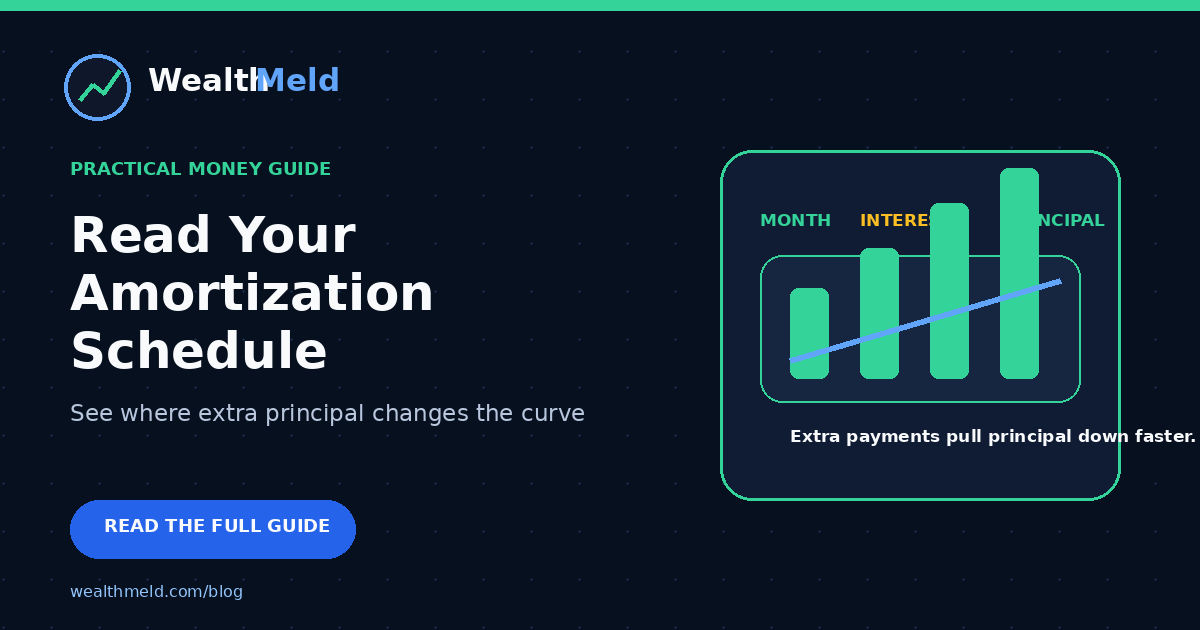
An amortization schedule shows how each payment is split between interest and principal. The payment amount may stay the same, but the interest part usually falls over time while the principal part rises. That pattern is why the early months of a loan can feel slow: a larger share of each payment is paying interest, not reducing the balance.
Reading the schedule helps you answer three practical questions: how much interest is left, when the balance will fall faster, and how much an extra payment can save. If your lender allows additional principal payments, the schedule becomes a planning tool instead of a static table.
What the schedule usually shows
- Payment date or period: the month or instalment number.
- Payment amount: the amount due for that period.
- Interest: the cost of borrowing for that period.
- Principal: the amount that reduces the balance.
- Remaining balance: what you still owe after the payment.
Use the schedule with the loan contract, not by itself. Fees, optional insurance, and payment application rules can change how the table behaves in real life.
Worked example
Assume a fixed-rate loan of CU 12,000 at 12.00% for 24 months. The base schedule has a monthly payment of CU 564.88. If the borrower adds CU 100 to principal each month, the term shortens and the total interest falls.
| Month | Payment | Interest | Principal | Remaining |
|---|---|---|---|---|
| 1 | CU 564.88 | CU 120 | CU 444.88 | CU 11,555.12 |
| 6 | CU 564.88 | CU 97.31 | CU 467.58 | CU 9,263.08 |
| 12 | CU 564.88 | CU 68.54 | CU 496.34 | CU 6,357.79 |
| 24 | CU 564.88 | CU 5.59 | CU 559.29 | CU 0 |
| 1 with extra CU 100 | CU 664.88 | CU 120 | CU 544.88 | CU 11,455.12 |
What this means: in the base case, the loan runs for 24 months and total interest is CU 1,557.16. With the extra CU 100 payment each month, the loan ends in 21 months and total interest falls to CU 1,299.90. That is an estimated interest saving of CU 257.26 and a term reduction of about 3 months.
How to read the pattern
- Check whether the interest column is falling as expected.
- Look at the principal column to see when balance reduction speeds up.
- Watch the remaining balance after each extra payment.
- Confirm that the lender applies extra money to principal, not to future interest or a reserve.
When extra payments help most
Extra principal has the biggest effect when the loan still has a long balance runway ahead of it. The earlier the extra payment goes in, the more future interest it can avoid. If the loan has a prepayment fee or a higher-value emergency fund is still missing, pause and compare both options before sending extra money.
Sources and further reading
Primary sources reviewed for this guide:
- Consumer Financial Protection Bureau — What is amortization and how could it affect my auto loan? Explains how fixed loan payments are split over time. Accessed 6 August 2026.
- Consumer Financial Protection Bureau — What is an annual percentage rate (APR)? Useful for understanding the borrowing cost that feeds the schedule. Accessed 6 August 2026.
Disclaimer
This article is general educational information, not personalised financial, investment, tax, accounting or legal advice. Examples use simplified assumptions and currency units for illustration only. Loan terms, fees, repayment rules, savings needs and tax treatment vary by country and by your individual situation. Check the actual contract or statement before making a financial decision.